Real-world robot imitation learning is often limited by the cost of collecting physical demonstrations,
which typically yield only one action label per visited state. We present CrowdMAPS, a
web-based crowdsourcing paradigm for augmenting real-robot datasets with
Multiple Actions per State (MAPS). After or during standard robot data collection,
CrowdMAPS distributes visited robot states to remote annotators through a web-based 3D interface, where
they specify alternative valid actions without requiring access to physical robot hardware. This expands
robot datasets along a complementary “width” dimension—by increasing
the number of actions per visited state—rather than only by collecting more trajectories. We
evaluate CrowdMAPS using keyframe-centric goal-pose annotations supplied by non-expert annotators and
train imitation policies on the resulting MAPS data. Across five real-world manipulation tasks,
increasing MAPS width from one to ten actions per state improves sample efficiency and
increases average success rates by 35.6 percentage points for keypose
policies and 33.0 percentage points for trajectory policies. These results show that
software-mediated human annotations can augment physical robot data to afford denser supervision,
establishing CrowdMAPS as a scalable digital layer for real-robot data collection.
Method
A single visited robot state often admits several valid next actions: a grasp can be approached from
slightly different poses, and a multi-step task can be completed in different orders. Standard imitation
learning datasets record only the one action that happened to be executed. CrowdMAPS decouples
hardware-bound state acquisition from software-scalable action annotation:
real robots provide physically grounded states, and remote annotators add alternative valid actions for
those states from a web browser, without access to robot hardware.
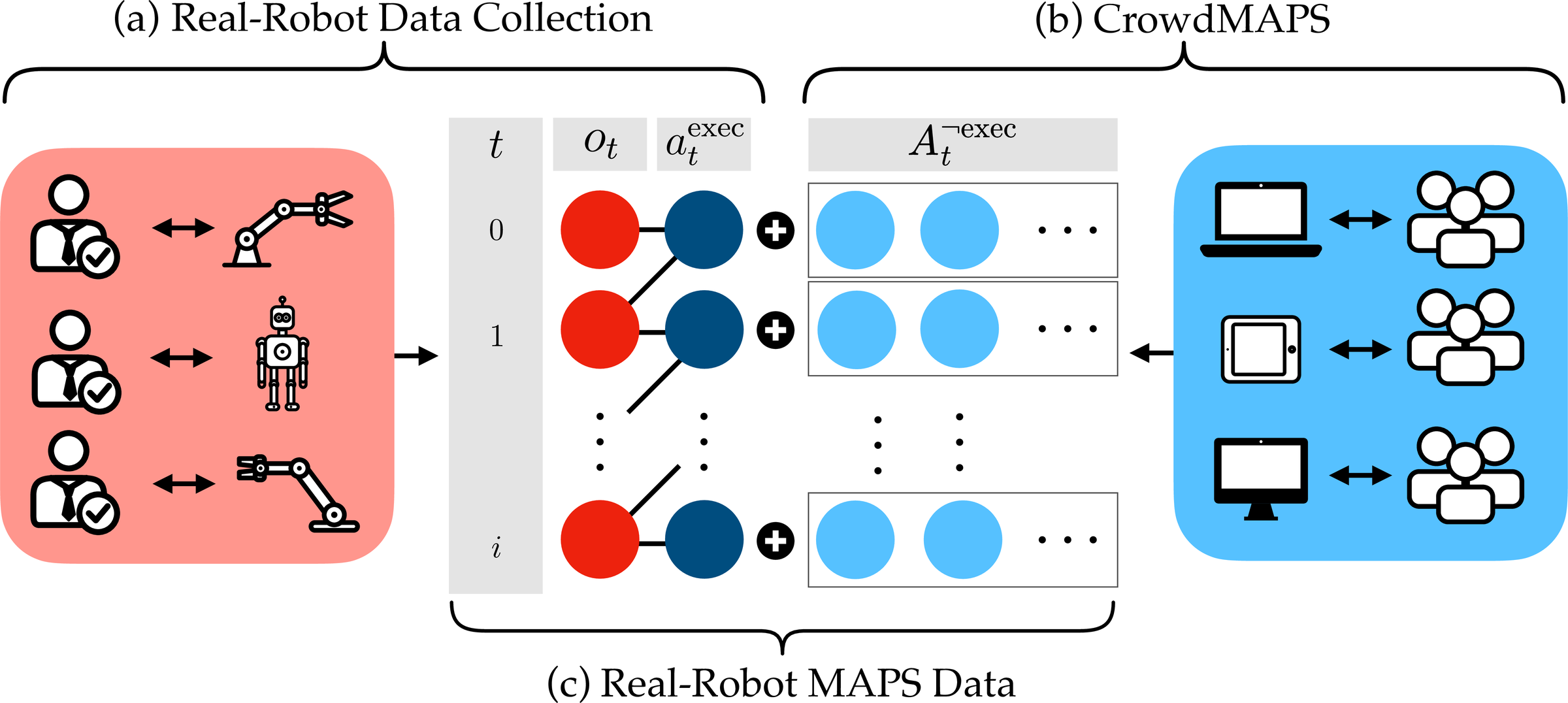
CrowdMAPS overview. After standard real-robot data collection (a), CrowdMAPS (b)
distributes visited states to remote annotators, who provide unexecuted alternative actions through a web
interface. The resulting real-robot Multiple Actions per State (MAPS) data (c) enables higher policy success
rates and sample efficiency.
Multiple Actions per State (MAPS)
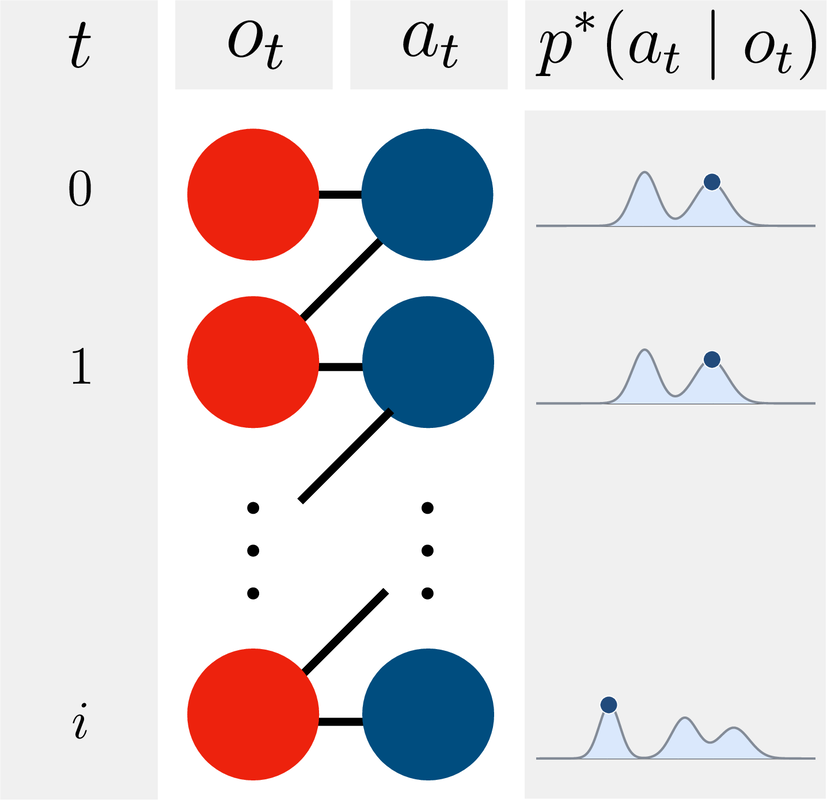
A standard trajectory pairs each visited observation ot with one executed action
at. A MAPS dataset keeps exactly the same visited observations but pairs each of them with
a set of valid actions At: the executed action plus valid, unexecuted alternatives
At¬exec. The number of actions per state, K, is the dataset’s
“width.” Under independent sampling, MAPS data scales the action-dependent variance of the
imitation-learning gradient estimator by 1/K, without introducing bias.
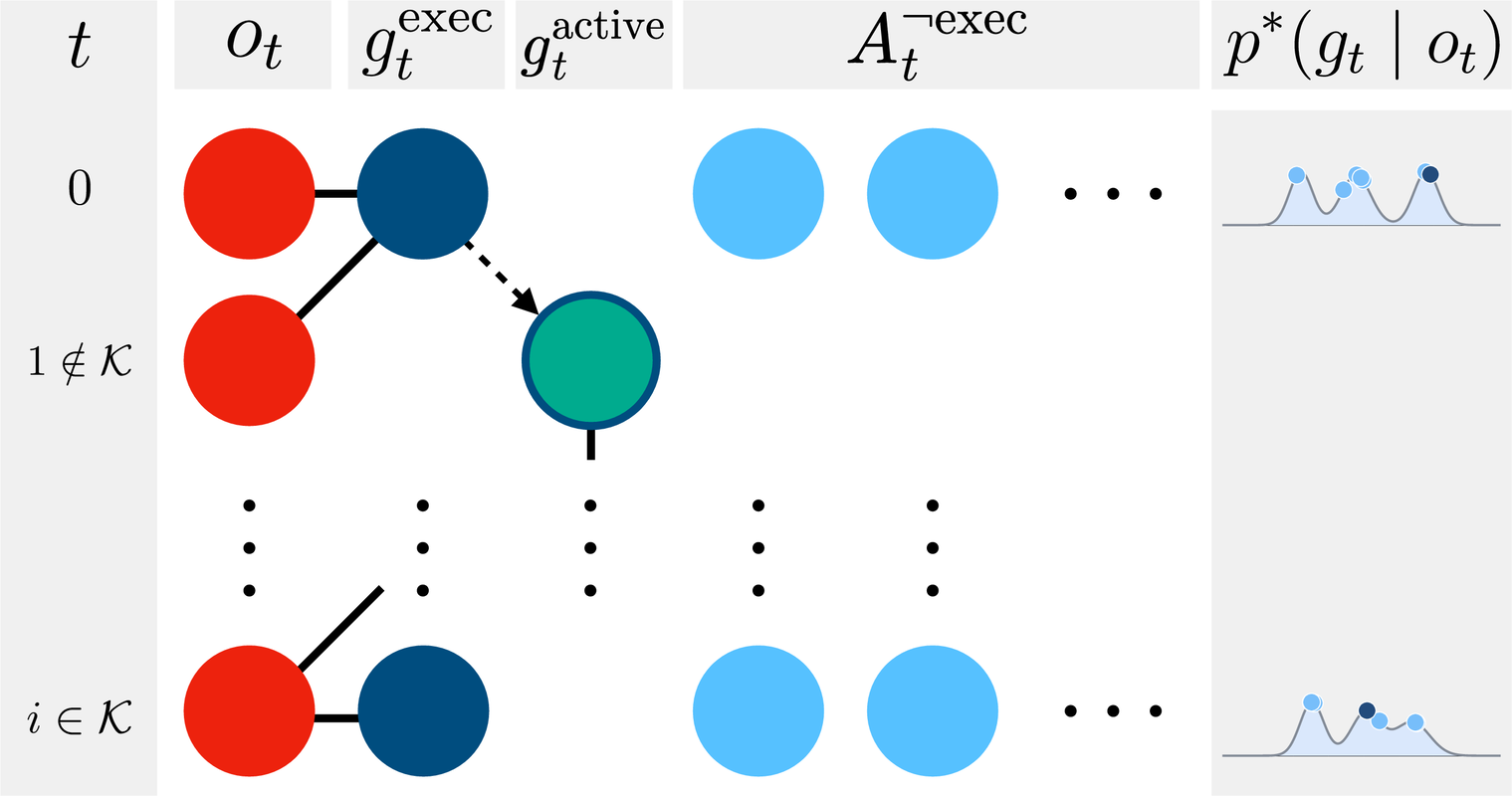
In our implementation, every action is a goal pose (end-effector position, orientation,
and a gripper open/close command) that a motion planner executes. Annotation is
keyframe-centric: keyframes, which occur at the start of a trajectory and whenever a goal
is reached, store the executed goal pose plus crowdsourced alternatives, while intermediate frames are
paired with the goal currently being pursued.
Standard trajectory dataset
MAPS dataset (keyframe-centric)
Standard trajectory data vs. keyframe-centric MAPS data. CrowdMAPS preserves the executed
trajectory but augments selected keyframes with additional valid, unexecuted goal-pose labels. This increases
the density of action labels per visited state without creating additional real-world transition branches.
Web-Based Crowdsourcing
CrowdMAPS collects alternative goal poses in two stages:
State acquisition. An expert collects standard real-robot trajectories using the same
goal-pose representation.
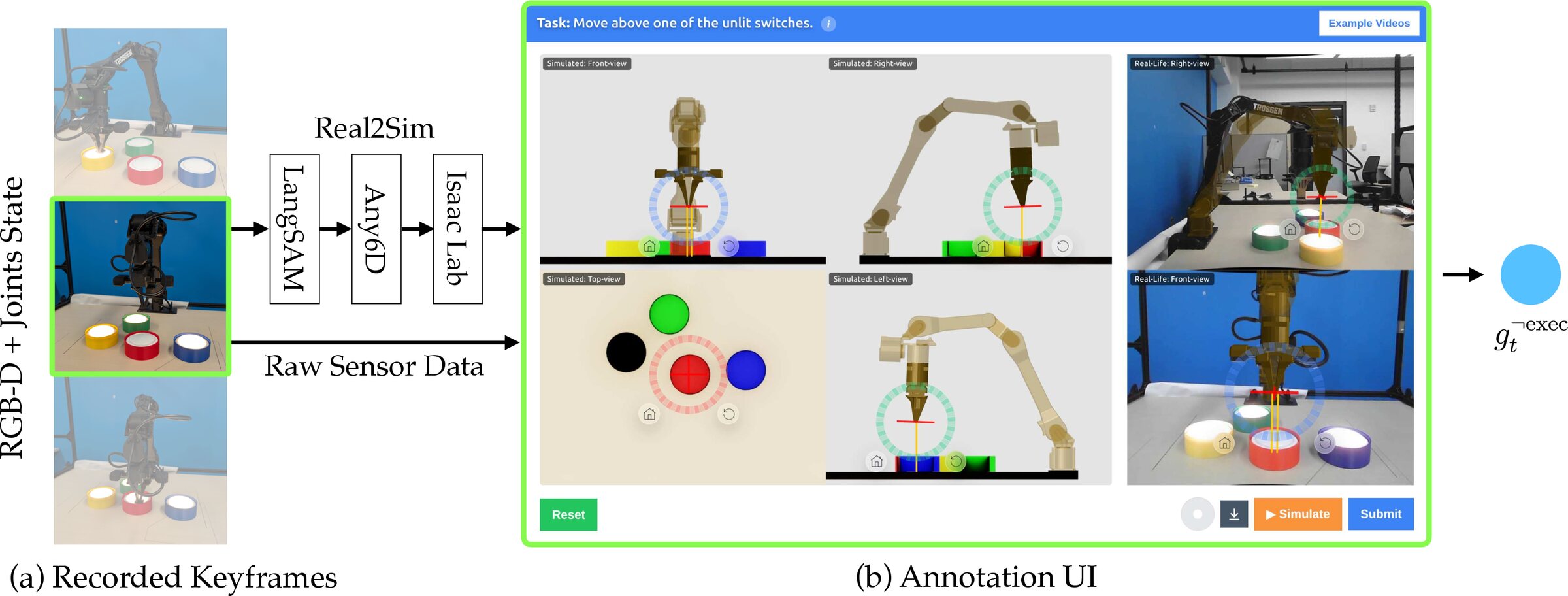
Action densification. Recorded keyframes are distributed to remote annotators. For each
keyframe, LangSAM segments the task objects, Any6D estimates their 6-DoF poses, and the corresponding CAD
meshes are placed in Isaac Lab to reconstruct the scene. Annotators manipulate a rendered robot in this
reconstruction, alongside the raw camera views, to specify an alternative goal pose.
A researcher validates each submission for consistency with the manipulation strategy used during physical
data collection, semantic alignment with the keyframe instruction, and physical coherence. Because
annotation needs no robot, many people can contribute at the same time, avoiding the one-user-one-robot
bottleneck of synchronous web teleoperation.
CrowdMAPS web annotation pipeline. Recorded real-robot keyframes (a) contain RGB-D and
proprioceptive data. Using task-specific CAD models and object text descriptions, LangSAM segments the
relevant objects, Any6D estimates their 6-DoF poses, and the corresponding meshes are placed in Isaac Lab to
reconstruct the scene. The reconstructed scene is displayed alongside raw sensor views in the annotation
interface (b), where annotators manipulate the rendered robot to specify an alternative goal-pose action.
Learning from MAPS Data
Keypose policies predict the next goal pose directly and are supervised on every label
in each action set. We adapt Diffusion Policy for this setting.
Trajectory policies are diffusion policies that predict action chunks. Each MAPS goal
pose is converted into a synthetic chunk by interpolating from the current end-effector pose, and the
policy is co-trained on these chunks and on continuous expert demonstrations.
Because alternative actions are never executed, the states they would lead to are absent from the data. We
call this MAPS shift and mitigate it in two ways: validation keeps crowdsourced actions within the
chosen manipulation strategy, and the loss weights executed actions above unexecuted alternatives, which in
turn are weighted above intermediate-frame goals.
Crowdsourcing with Non-Experts
We recruited 47 participants through university mailing lists and social media; 78.7% had no prior
experience with robot arms. Across the four tasks with timing logs, the median submission took 7 to 12
seconds, so annotators can contribute in short sessions rather than through sustained teleoperation.
Submission acceptance rates were 51% for Drawer, 98% for Insertion, 66% for Pouring, 83% for Sorting, and
94% for Switches, and annotators generally became faster and more accurate with practice.
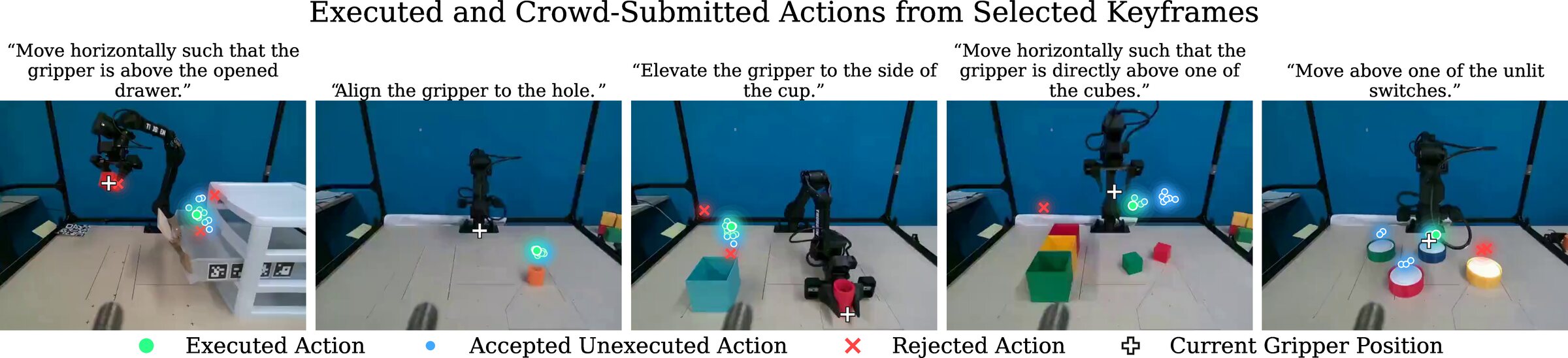
Crowdsourced labels for selected keyframes. Executed and crowd-submitted end-effector goal
poses projected onto the image observation for one keyframe from each task. Rejected actions can be
semantically incorrect or physically incoherent. Accepted actions cover the valid action distribution both
within a mode and across modes.
Results
Wider MAPS data improves keypose policies
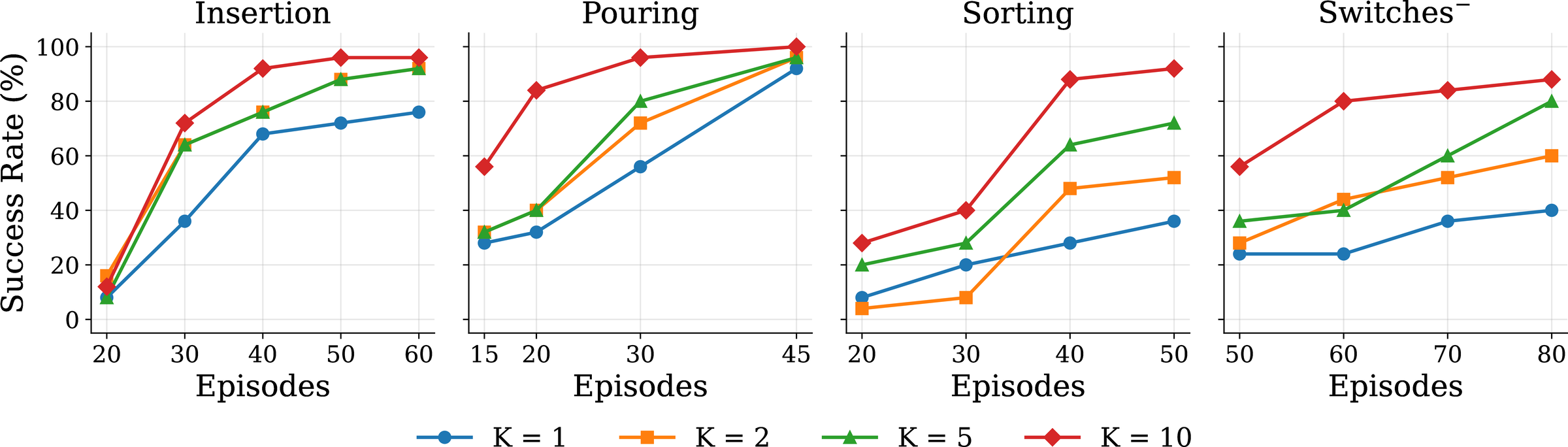
Averaged across all task and dataset-size settings, increasing width from K = 1 to
K = 10 raises success from 38.7% to 74.2%, a gain of 35.6 percentage points. The effect is
strongest on longer-horizon and multimodal tasks: on Sorting and Switches−, it averages
42.5 points, and K = 10 is the only width that exceeds 85% success.
K
Drawer
Insertion
Pouring
Sorting
Switches−
5
20
30
40
50
60
15
20
30
45
20
30
40
50
50
60
70
80
1
12
8
36
68
72
76
28
32
56
92
8
20
28
36
24
24
36
40
2
52
16
64
76
88
92
32
40
72
96
4
8
48
52
28
44
52
60
5
76
8
64
76
88
92
32
40
80
96
20
28
64
72
36
40
60
80
10
76
12
72
92
96
96
56
84
96
100
28
40
88
92
56
80
84
88
10 (noise)
4
12
68
88
68
52
32
16
52
80
0
8
60
24
40
56
52
68
Keypose policy performance as MAPS width increases. Top: success rates (%) for keypose
policies trained with different MAPS widths K; the numbers under each task are the numbers of
training trajectories. Bottom: scaling trends for crowdsourced MAPS widths. Each entry is evaluated over 25
real-world rollouts with randomized initializations; best results are in bold. Switches−
starts with three of the four lights already on.
The K = 10 (noise) row replaces every crowdsourced alternative with a Gaussian perturbation
of the executed action, with covariance estimated from the crowd annotations themselves. Despite matching
the action density of K = 10, it reaches only 43.3% average success, compared with 74.2%
for crowdsourced labels. It also gets worse with more data in several settings: from 88% to 52% on
Insertion and from 60% to 24% on Sorting.
Sharper, better-separated action modes
We sample 100 goal-pose predictions from keypose policies trained with K = 1, 2, 5, 10 at
the same held-out keyframe. On the unimodal Insertion task, wider MAPS data shrinks both the offset and the
spread of the predictions. On the multimodal Sorting task, low-width policies smear predictions between the
two cubes, whereas at K = 10 the policy represents both valid choices as distinct, sharp
modes.
K = 1K = 2K = 5K = 10
(a) Insertion
(b) Sorting
Policy predictions at held-out keyframes. Purple markers denote predictions; the white cross
denotes the current gripper position. (a) Insertion: increasing K reduces both the offset and the
dispersion of the predictions. (b) Sorting: increasing K results in sharper, more clearly separated
valid action modes.
What drives the gain from wider MAPS?
MAPS adds action labels only at states the robot already visited, so the gains cannot come from broader
state coverage. We attribute them to two compounding effects: within-mode densification
(denser sampling of valid actions around one solution) and multimodal coverage (distinct
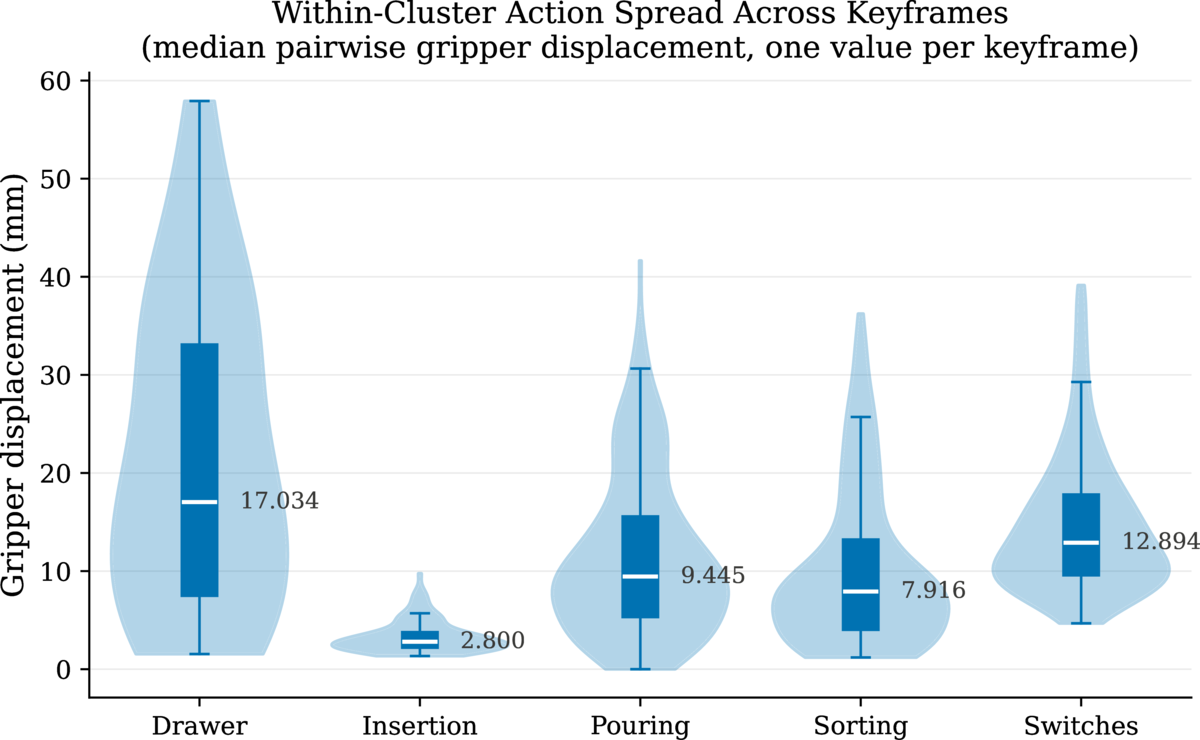
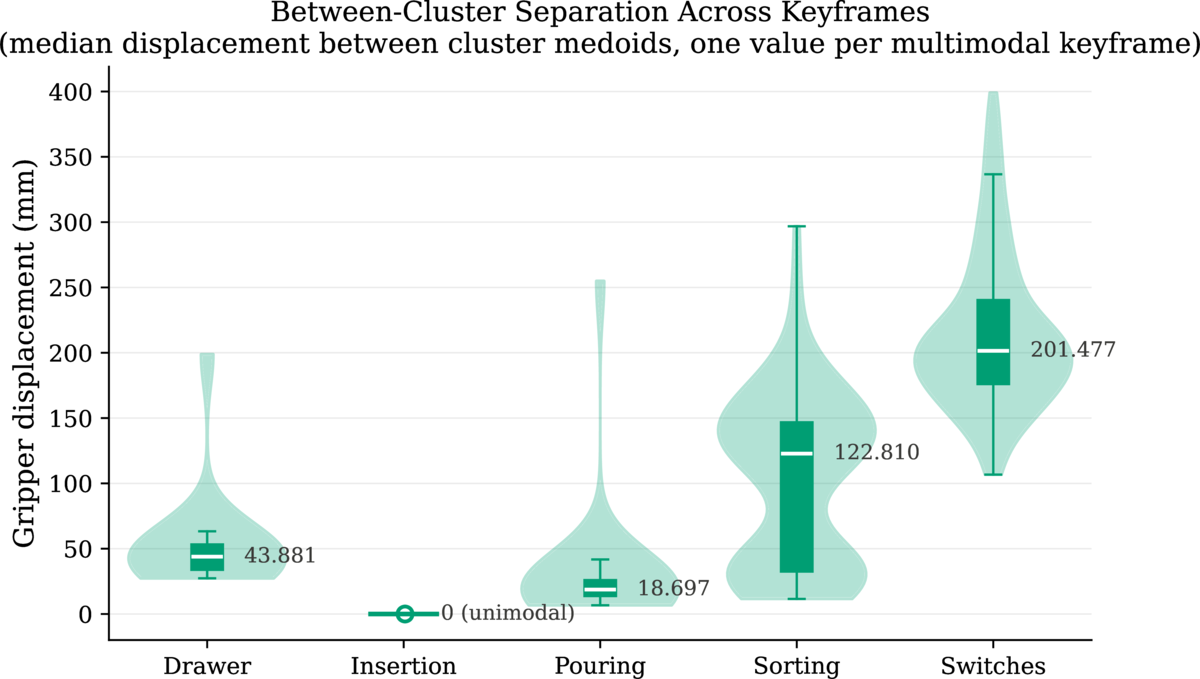
valid solutions represented at the same state). Crowd labels show both: the median within-mode spread
ranges from 2.8 mm (Insertion) to 17.0 mm (Drawer), while distinct modes on Sorting and Switches
are separated by a median of 122.8 mm and 201.5 mm. Consistently, the improvement from
K = 1 to K = 10 grows with multimodality: +22, +32, +39, and +46
percentage points on Insertion, Pouring, Sorting, and Switches−.
(a) Within-mode spread
(b) Between-mode separation
Geometric structure of crowdsourced actions. Distances measure the maximum displacement of
fixed reference points on the gripper body between two goal poses, so both translation and orientation
differences contribute, in millimetres.
MAPS data transfers to trajectory policies and outperforms more teleoperation
Starting from a base set of expert demonstrations, we compare adding more expert teleoperated trajectories
with adding CrowdMAPS data. At K = 1, MAPS data often underperforms extra teleoperation,
since single keyframe labels carry less temporal detail. As K grows, denser supervision makes up for
this: increasing width from 1 to 10 improves average success by 33.0 percentage points, and at
K = 10 MAPS data gives the best result on every task.
The comparison approximately matches robot time (2.2 hours for MAPS data vs. 2.3 hours for the added
expert trajectories) but not total human effort: at matched performance, MAPS data required about
1.5× more human time.
Trajectory policy performance under different data augmentation strategies. All methods start
from the base expert demonstrations Ebase. We compare adding expert trajectories
Eadded with adding MAPS data DMAPS at different widths K. Results
are success rates over 25 rollouts, except Switches+, which is reported as activated lights out of
100. Best results are in bold. Switches+ requires activating all four lights.
 : Crowdsourcing Multiple
Actions per State for Real-World Robot Imitation Learning